
Tinley Park, IL · Garage Door Service
Detached vs Attached Garages: What Changes for Tinley Park Homeowners
How Tinley Park's 1960s-70s housing stock and cold winters change what matters for detached vs attached garage door setups, and what to check first.
- Repairs & new doors
- Springs & openers
- Serving 7 nearby communities
The Problem
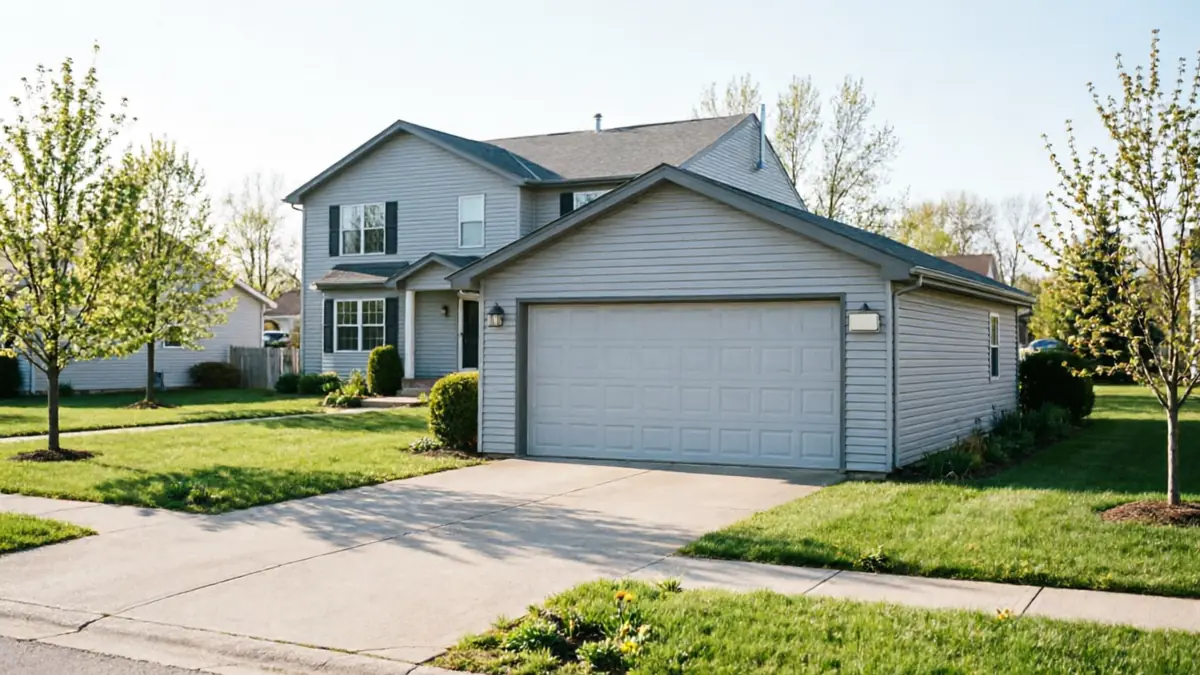
Most of the houses around Tinley Park went up between 1938 and 2004, with the median build year sitting at 1972, and the bulk of the stock in this area dates to the 1960s and 70s. That matters here because builders in that era split pretty evenly between attached garages tucked under the main roofline and detached garages set back near the alley or rear lot line, often on older lots that predate the subdivisions. The two setups age differently. An attached garage shares a wall and sometimes a ceiling cavity with living space, so the door, the weatherstripping, and the header framing are all working against heated or semi-heated air on the other side. A detached garage has none of that buffer. It's a cold box year-round, which means the door, the spring, and any opener mounted inside are exposed to the same temperature swings as the outside air, with no help from the house. On a 1970s detached structure, we also see more non-insulated sectional doors than on the newer attached builds, because nobody insulated a structure nobody was heating.
How Local Conditions Play In
Tinley Park sits in a cold, moderate climate band, not the deep-freeze extremes you'd get further north, but enough seasonal swing that steel contracts and expands all winter. On an attached garage, that swing is dampened some by shared house heat leaking through the common wall. On a detached garage, there's nothing dampening it. The door panels, the torsion spring, and the track hardware all see the full range of outdoor temperature, which is why detached-garage springs and rollers tend to show wear sooner on homes built in that 1960s-70s window - the galvanizing and the steel gauge from that era weren't spec'd for today's loads. If your detached garage was built as a standalone structure on an older lot rather than added later, check whether the header and track were ever upgraded; a lot of original 1960s hardware is still out there holding up doors it was never rated for by today's standard.
When Waiting Is Fine
Not every noise or stiff spot needs a same-week call. If you've got an attached garage and the door is sluggish only on the coldest mornings, that's often just grease gone stiff in the cold - not a sign the opener or spring is failing. Give it a season to see if it's consistent before you spend money. On a detached garage, a little more rust bloom on hardware that's never under a roof overhang is normal and doesn't mean the spring is about to fail; surface rust on 50-year-old steel is cosmetic until it's pitting the coil itself. Where we tell people to wait: a door that still seals fully and opens smoothly, even if it looks rough, especially on older detached structures where the door was never insulated to begin with - insulating it now is a bigger job than the door itself, and it's a legitimate call to hold off until something else fails.
What to Look At First
Start with where the garage sits relative to the house. If it's attached, check the weatherstrip at the bottom panel and the seal where the door meets the jamb - on 1960s-70s construction that seal is often the original, undersized style. If it's detached, go straight to the spring and the track mounting, since that structure has had decades of full outdoor temperature swings with no insulation buffer. Either way, on a home from this era, don't assume the opener is original; most have been replaced at least once, but the door panel and track hardware often haven't. We don't do remote structural repair - if the header over a detached garage door has sagged or the framing's pulled away from the slab, that's a carpentry call before it's a door call, and we'll tell you that straight instead of forcing a door into bad framing.
Frequently asked questions
Does a detached garage need a different door than an attached one in Tinley Park?
Not a different door model necessarily, but a detached structure on an older Tinley Park lot sees the full outdoor temperature swing with no help from house heat, so the spring and hardware wear differently. We'd size the door the same way, but we'd look harder at the spring and track condition before recommending a repair versus replacement.
Why does my detached garage door feel stiffer in winter than my neighbor's attached one?
An attached garage picks up some ambient heat through the shared wall, which keeps grease and springs more workable. A detached garage has no buffer from the house, so in our cold moderate climate band the steel and lubricant both stiffen more on a standalone structure.
My house was built in the 1960s - is the original door hardware still safe?
Not necessarily. A lot of homes in this area still run original torsion springs and track from that era, and steel specs and galvanizing have improved since then. It's worth a look, especially if the garage is detached and has had zero insulation or heat buffering for fifty-plus years.
Related garage door services in Tinley Park
More garage door guides
Book garage door service in Tinley Park
Call now or request a quote - tell us what the door is doing and where you are.