
Tinley Park, IL · Garage Door Service
Why a Door Goes Off Track in Tinley Park
Tinley Park homes built mostly in the 1960s and 70s face a specific off-track problem in cold winters. Here's what to check before you call anyone.
- Repairs & new doors
- Springs & openers
- Serving 7 nearby communities
The Problem
A door that's jumped its track almost never does it in one dramatic moment. It happens over months, sometimes years, as a roller works loose from a bent track bracket or a cable starts to fray on a drum that's slightly out of alignment. On a lot of the doors we see here, the original hardware dates back decades - Tinley Park's housing stock runs from 1938 to 2004, with the median build year sitting at 1972 and most of the surrounding named areas built up through the 1960s and 70s. That means a huge share of the doors in this area are either original equipment from that build-out or a first-generation replacement installed sometime in the 80s or 90s. Track brackets from that era were often screwed straight into aging jamb wood that's shifted slightly with the house. Add a roller that's worn thin and the door rides just far enough off center that one hard stop - a kid hitting the wall button, a remote double-press - pulls it clean off the rail. The fix is rarely the whole door. It's usually the track, the bracket, or a handful of rollers that have been quietly failing for a long time before anyone noticed.
How Local Conditions Play In
Tinley Park sits in a cold, moderate climate band, and that matters more for off-track doors than most people assume. Steel track contracts in freezing temperatures, and if a bracket was already a little loose from age, the cold pulls the gap open just enough for a roller to walk out of the channel on the next open-close cycle. Grease on older rollers and hinges also stiffens up in winter, which makes the door travel unevenly instead of gliding straight - one side drags, the other doesn't, and the door racks sideways against the track. We see this most on homes with original 1960s and 70s hardware that's never been relubricated or realigned. It's not a dramatic failure. It's a slow one that finally shows itself the first really cold week of the year, when everything in the system is working a little harder and a little less forgiving than it was in July.
When Waiting Is Fine
Not every wobble means a trip off the track is coming. If the door is tracking straight, closing flush, and the rollers aren't visibly leaning or chewed up where they meet the track, you can leave it alone and just watch it. A little surface rust on an older track isn't an emergency - it's cosmetic until it isn't. Where we tell people to wait: a door that's slightly noisy but still travels evenly, or one roller that looks original but shows no play when you wiggle it by hand. Replacing hardware preventively on a door that's behaving fine is money spent on a problem you don't have yet. The honest version of our advice is that we'd rather you call once something actually shows a gap, a lean, or a grinding sound than have us swap parts on a schedule that has nothing to do with what your door is actually doing.
What to Look At First
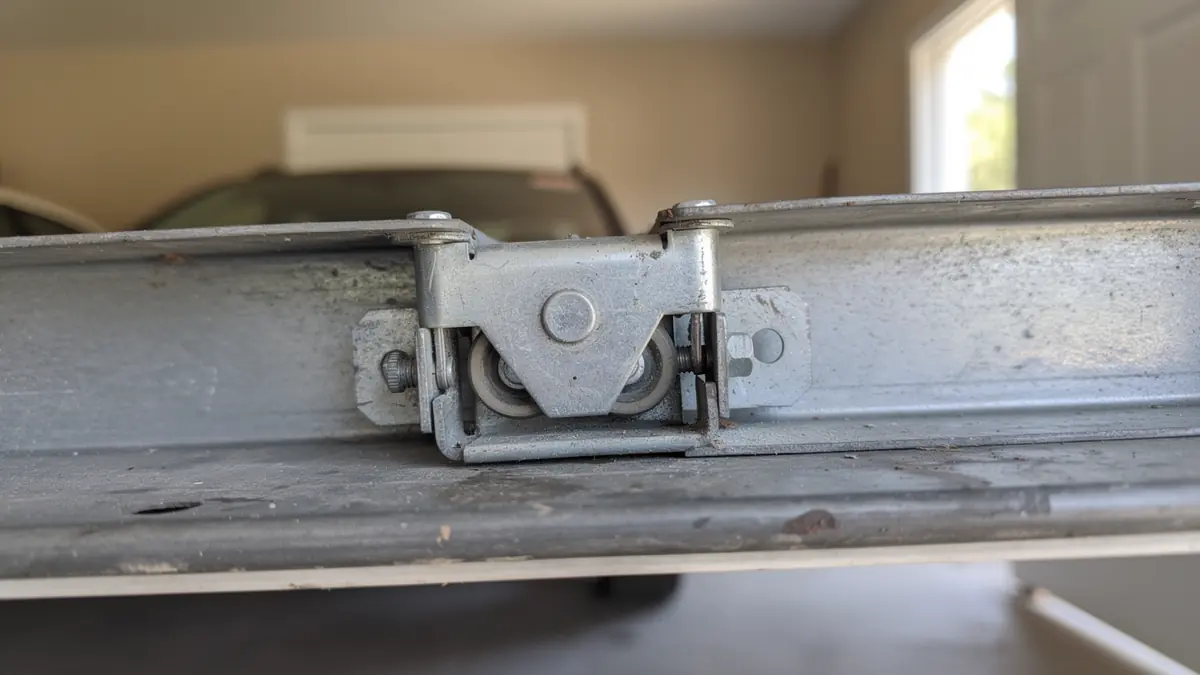
Before anything else, look at where the roller meets the track, both sides, top to bottom. A roller sitting visibly outside the channel, or a track bowed out at the bottom bracket, is your answer - that's where it's going to let go next. Check the brackets themselves for loose screws; on a lot of Tinley Park's 1960s and 70s builds, those are original fasteners in original wood, and decades of vibration work them loose slowly. Run the door by hand with the opener disconnected and feel for a spot where it binds or drags - that's usually the cold-stiffened hinge or a flat-spotted roller doing the damage. If you see a cable that's frayed or unwound near the bottom drum, stop there and don't keep running the door; that's a tension problem, not a track problem, and it's a different repair. We work Tinley Park and the surrounding area, and track and roller calls are some of the most common ones we take, especially this time of year.
Frequently asked questions
Can I push a garage door back onto its track myself?
We don't recommend it. The track holds the door under spring tension, and forcing a panel back into the channel without releasing that tension first can snap a cable or bend the track further. If the door is off the track, leave it where it is and call someone who can release tension safely before touching it.
Is an off-track door always a sign I need a new door?
No. Most of the time it's the track, a bracket, or a set of rollers, not the panels themselves. Given how much of Tinley Park's housing stock is from the 1960s through the 90s, we replace hardware on original doors far more often than we replace the whole door.
Why does this seem to happen more in winter here?
Cold temperatures make steel track contract and old grease stiffen, so a door that was already riding slightly off-center in warmer months finally has enough play to jump the channel. It's usually the end of a slow problem, not a new one caused by the cold alone.
Related garage door services in Tinley Park
More garage door guides
Book garage door service in Tinley Park
Call now or request a quote - tell us what the door is doing and where you are.