Tinley Park, IL · Garage Door Service
Is Your Older Tinley Park Garage Door Worth Fixing
A look at when a Tinley Park garage door built during the 1960s-70s boom is worth repairing, and when the cold-climate wear tips the math toward replacement.
- Repairs & new doors
- Springs & openers
- Serving 7 nearby communities
The Problem
Most of the garage doors we get called on in Tinley Park were installed somewhere between 1938 and 2004, with the bulk of the neighborhood going up in the 1960s and 70s. That means a lot of doors on the street are 40 to 60 years old, and a lot of homeowners are stuck wondering if a repair is throwing money at something already on its way out.
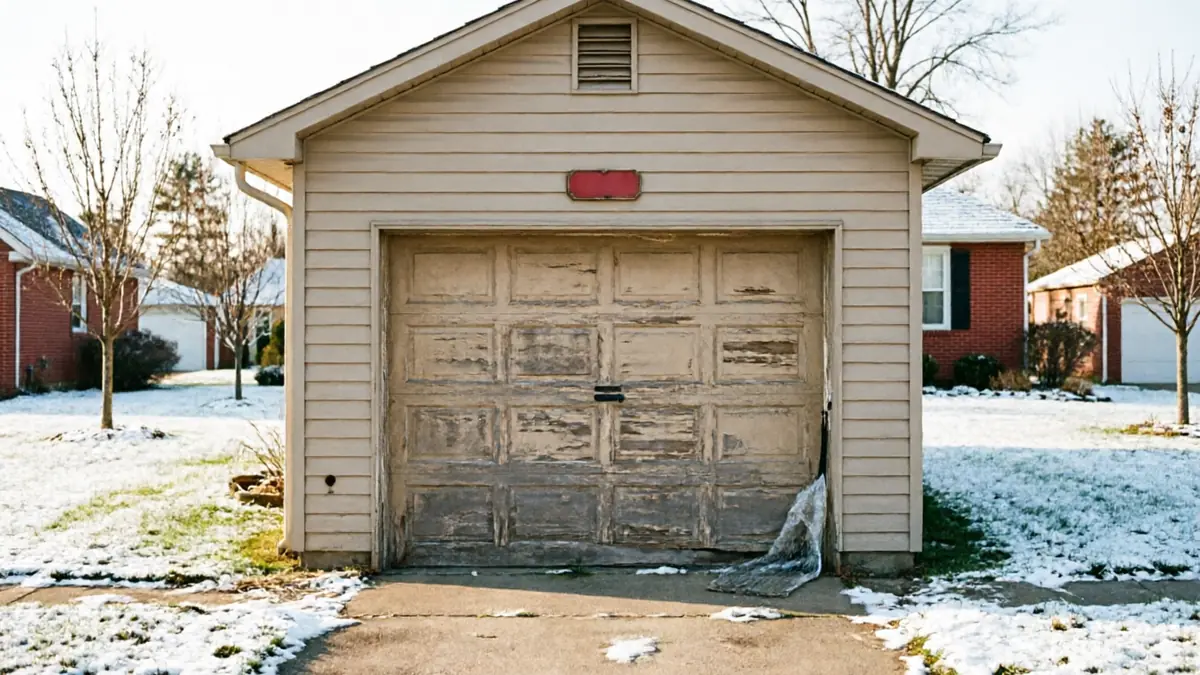
The honest answer depends on what's actually broken, not the age printed on a permit. A torsion spring, a set of rollers, even a section of track - these wear out on a schedule that has nothing to do with the door's birth year, and swapping them is cheap compared to a full replacement. What changes the math is the door itself: steel that's rusted through at the bottom panel, a wood door that's swelled and cracked from decades of freeze-thaw, or hardware so old the parts aren't made anymore. On a house built in 1965, you're more likely to be looking at one-piece construction or early sectional steel that doesn't share parts with anything on the shelf today.
We look at the door in front of us, not a chart. If the panels are sound and the track is straight, fixing it almost always wins.
How Local Conditions Play In
Tinley Park sits in a cold, moderate climate band, and that matters more to an older door than people expect. Cold winters mean repeated freeze-thaw cycles on anything with exposed hardware - hinges, rollers, the bottom seal - and on a door that's already 40 or 50 years old, that cycle has had a lot more time to do damage than it has on a door installed in the last decade.
Houses built in the 1960s and 70s boom years in this area often still run original torsion springs or early extension spring setups that were never designed with today's insulation standards in mind. In a cold winter, an underpowered or fatigued spring has to work harder just to lift a door that's picked up moisture weight over the years. That's where we see the sudden snap - not because the door failed overnight, but because decades of cold-season stress finally caught up with hardware that was already near the end of its rated cycles.
If your door is from that same era and you're hearing new noises in the cold months - grinding on lift, a slow start, a track that's binding - that's usually the climate finishing a job age already started. It's worth a look before it's a 6 a.m. no-start on a 10-degree morning.
When Waiting Is Fine
Not every creak from an old door means trouble. If your door is from the 1960s-70s stock common across this area and it's still opening smooth, closing flush, and the springs aren't showing fraying or gaps in the coil, there's no reason to replace anything on a guess.
Cosmetic wear - faded paint, small dents, a weatherstrip that's gone stiff but still seals - isn't worth tearing into. Those are maintenance items, not safety items, and they don't get worse overnight the way a cracked spring or a bent track does.
We'll also say plainly: if a repair is going to cost nearly what a new door runs, and the door is already past its expected service life for its era, we'll tell you that instead of doing the repair anyway. That's the one honest limitation worth stating here - we don't patch a door just because patching is the call we got. Sometimes the right answer is to wait and watch, and sometimes it's to replace, but either way it should be based on what the door is doing, not just its age on paper.
What to Look At First
Before you decide anything, check three things yourself. First, the springs - look for visible gaps in the coil or rust streaking down from the center bracket, especially on a door from the 1960s-70s era where original torsion hardware is still common. Second, the track - stand to the side and watch it open; if it wobbles or the rollers jump, that's wear, not age by itself.
Third, the bottom panel and seal, since that's the part most exposed to Tinley Park's cold-season freeze-thaw swings. Rust-through or a seal that's cracked stiff means moisture has been getting in for a while, and that's a different repair than a worn spring.
If two of the three are still solid, the door is almost always worth fixing rather than replacing. If all three are showing age at once, that's usually the point where a repair just buys a few more months before the next call.
Frequently asked questions
My garage door is from the 1960s - is it even worth repairing?
Usually yes, if the panels and track are sound. A lot of Tinley Park houses were built in that decade, and the steel doors from that era hold up fine structurally - it's the springs, rollers, and seals that wear out. Those are straightforward, affordable fixes. Age alone isn't a reason to replace.
Why does my old door act up more in winter?
Cold hits old hardware harder. In this area's cold, moderate climate, repeated freeze-thaw cycles stress hinges, rollers, and springs that are already decades old. A spring near the end of its life often picks winter to finally go, since the door is heavier and stiffer in the cold and the hardware is working harder to compensate.
How do I know if it's time to stop repairing and replace?
When the repair cost gets close to replacement cost, or when multiple parts are failing at once - springs, track, and panel rust all showing up together - that's usually the sign. One worn part on an older door is a repair. Three worn parts at the same time is usually the door telling you it's done.
Are original parts from a 1960s or 70s door still available?
Not always. Original hardware from that era sometimes doesn't match current stock sizes, which is one of the real limits of fixing an old door. In those cases we use a compatible modern replacement part rather than hunting for an exact original, and it works fine - it just isn't identical.
Related garage door services in Tinley Park
More garage door guides
Book garage door service in Tinley Park
Call now or request a quote - tell us what the door is doing and where you are.