
Tinley Park, IL · Garage Door Service
When a Garage Door Repair Stops Being Worth It in Tinley Park
A look at when a garage door repair in Tinley Park stops making sense, based on the area's 1960s-70s housing stock and its cold-moderate climate band.
- Repairs & new doors
- Springs & openers
- Serving 7 nearby communities
The Problem
Most of the calls we get aren't about a door that won't move at all. They're about a door that's been patched two or three times already, and the owner wants to know if one more repair is the right call or just throwing money at something that's done. Houses here went up mostly between 1938 and 2004, with the bulk clustered in the 1960s and 70s across the area's 85 named subdivisions, which means a lot of original steel sectional doors and torsion hardware are now pushing fifty years old. A spring on a door that age isn't the problem - it's a symptom. The track is worn into a shape that doesn't match a new roller, the panels have flexed enough times that the seams are tired, and the opener was never rated for the door's current weight once two or three panels got swapped out over the years piecemeal. At some point you're not repairing a door anymore, you're repairing a patchwork of decades.
How Local Conditions Play In
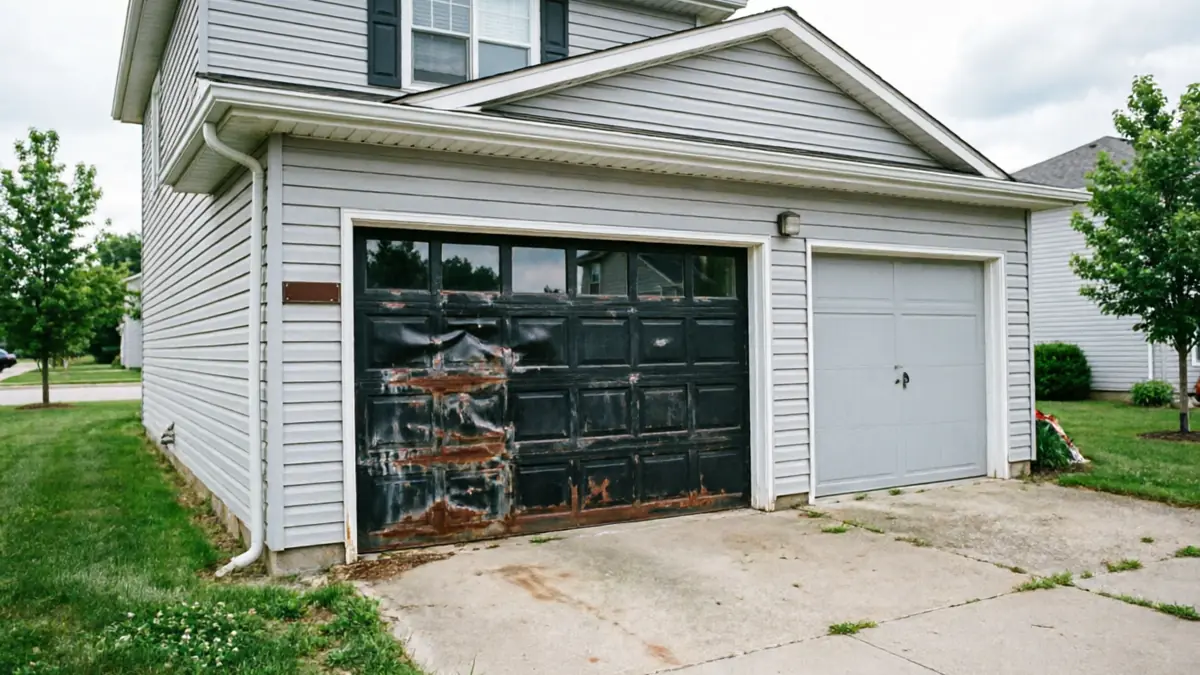
Tinley Park sits in a cold-moderate climate band, so a door that's lost its seal isn't just a nuisance - it's a path for frost and condensation straight onto a slab that wasn't built with a thermal break. On a door from the 1960s-70s era common in this area, the bottom seal track is often rusted into the panel itself, so a new seal doesn't seat right no matter how many times you replace it. That's a sign the panel, not the seal, is the real problem. Cold snaps also tell you a lot fast: a torsion spring that's been slowly losing tension all year will usually snap on the first hard-cold morning of the season, because cold steel is less forgiving. If you've had two spring failures in two winters on the same door, that's not bad luck - that's a door telling you it's at the end of its service window.
When Waiting Is Fine
Not every noisy or slow door needs a truck out this week. If the door still closes flush, the opener reverses properly when it hits something, and the only issue is a roller that squeals or a hinge that's stiff, that's maintenance, not an emergency, and it can wait for a scheduled visit. With a median household income of $80,753 across the service area, most owners here can afford a full replacement rather than stacking patch repairs on a door that's already at the end of its service life, but that doesn't mean every repair should jump straight to replacement. A single cracked roller or a loose bottom bracket on a door that's otherwise sound is worth fixing on its own. Save the bigger decision - repair versus replace - for when more than one system on the door is failing at once.
What to Look At First
Start with the panels, not the spring. If you're within a few miles of Orland Hills or Frankfort Square, your house was likely built in the same wave as homes here, and the opener and spring sizing used on those 1960s-70s builds doesn't always match what's sold off the shelf today, which is why a spring swap alone sometimes doesn't fix a door that still sags or binds. Look for rust at the bottom corners, daylight gaps at the seams, and a track that's bowed rather than straight. Across the 432,398 households and 228,728 owner-occupied houses in this service area, the single biggest reason doors get replaced instead of repaired is a bent track paired with a cracked panel on a door built before the 1990s. If you've got both at once, a repair quote is worth getting, but go in expecting the honest answer might be a new door instead.
Frequently asked questions
How do I know if my garage door is too old to repair?
If the door is from the original build era common in this area - roughly 1960s to 70s construction - and you're looking at more than one failed system at once, like a cracked panel plus a bent track, repair costs start stacking up fast. A single worn part on an otherwise sound door is usually still worth fixing.
Does cold weather make garage door problems worse here?
Yes. Tinley Park sits in a cold-moderate climate band, and a torsion spring that's already weakening tends to fail on the first hard-cold morning rather than gradually. If you've had repeat spring failures in winter, that's a sign the door is near the end of its life, not just bad timing.
Is it ever worth repairing an original 1960s or 70s door?
Sometimes. If the panels and track are still straight and the only issue is a worn roller or a tired spring, a targeted repair makes sense. Once the panel itself is rusted or the track is bowed, you're usually better off putting that money toward a new door.
Related garage door services in Tinley Park
More garage door guides
Book garage door service in Tinley Park
Call now or request a quote - tell us what the door is doing and where you are.